Dressed to Terrify (Yourself, Then Everyone Else): The Science of Wearing Bold
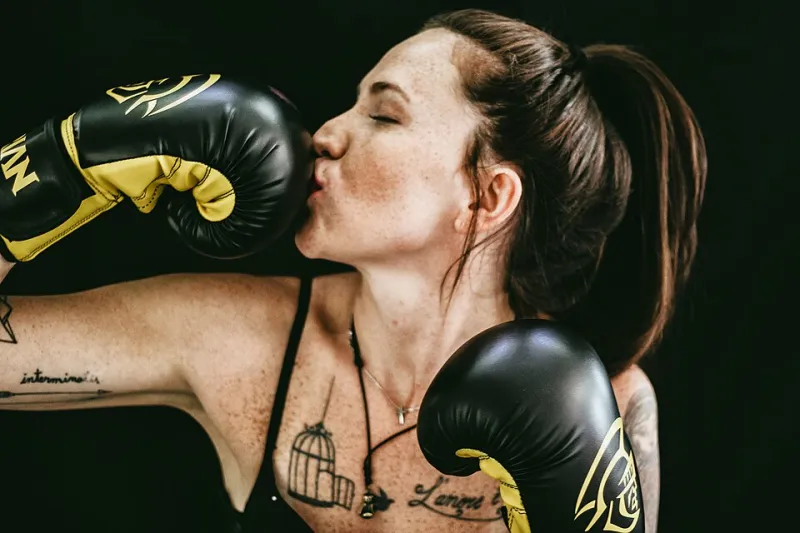
Photo: Matheus Ferrero matheusferrero, CC0, via Wikimedia Commons
Let's get one thing straight: nobody walks out of the house in a chartreuse jumpsuit with embroidered frogs on the lapels and accidentally feels confident. That kind of outfit requires a decision — a full, conscious, slightly maniacal commitment. And according to a growing body of psychological research, that decision is doing something remarkable to your brain.
Welcome to what we at Tuba Pants like to call the Confidence Coefficient: the measurable, real, and honestly kind of hilarious relationship between wearing something that makes strangers do a double-take and feeling like you could negotiate a raise, parallel park on the first try, and survive a family dinner — all in the same afternoon.
Your Clothes Are Talking. Are You Listening?
Fashion psychologist Dr. Carolyn Mair, author of The Psychology of Fashion, has spent years documenting how what we wear shapes not just how others see us, but how we see ourselves. The concept of "enclothed cognition" — a term coined by researchers Hajo Adam and Adam Galinsky in a 2012 study published in the Journal of Experimental Social Psychology — suggests that clothing doesn't just signal identity, it actively creates it.
In their now-famous experiment, participants who wore a white coat they were told belonged to a doctor performed significantly better on attention tasks than those who wore the same coat but were told it was a painter's smock. Same coat. Different story. Completely different brain.
Now scale that up to a pair of wide-leg trousers in a print that looks like a tuba exploded into a Matisse painting. You're not just getting dressed. You're issuing a memo to your own nervous system.
"When someone chooses something genuinely unconventional," says Dr. Dawnn Karen, a New York-based fashion therapist and author of Dress Your Best Life, "they're practicing a form of self-authorship. They're saying, I am the one defining what this means. That's an incredibly powerful psychological stance."
In other words: weird clothes aren't a cry for attention. They're a declaration of editorial control over your own narrative.
The Stare Economy
Here's the part that trips people up: the fear of being looked at. Most of us spend a significant chunk of our mental energy trying to avoid standing out — blending into the beige backdrop of American business casual like a khaki chameleon. But research suggests that being looked at isn't the threat we think it is.
A 2014 study from Harvard Business School found that people who broke social norms in dress — showing up to a formal meeting in gym clothes, for example — were actually perceived as higher status than those who conformed, provided they carried themselves with assurance. The researchers called this the "red sneakers effect." The deviation from the norm read not as ignorance of the rules, but as confidence powerful enough to override them.
Tuba Pants reader Marisol T., a 34-year-old graphic designer from Austin, Texas, tested this theory without meaning to. "I wore these enormous floral palazzo pants to a client pitch — like, the flowers were the size of dinner plates — and I was terrified. But the client kept referencing them in conversation, kept saying things like 'the person with the great pants.' I got the contract. The pants got the credit."
She's not wrong. When you're the person in the extraordinary outfit, you become a landmark. People remember you. And being memorable, it turns out, is most of the battle.
The Rehearsal Nobody Told You About
Here's what's quietly happening every time you leave the house in something that makes your neighbor's dog stop and stare: you're rehearsing discomfort.
Psychologists who study exposure therapy and social anxiety note that one of the most effective ways to reduce fear of judgment is to experience judgment and survive it — repeatedly, until the brain recalibrates its threat response. Wearing a statement outfit is, in miniature, exactly that exercise. Every day you put on something bold and walk through the world and don't spontaneously combust, your brain files away a small but significant data point: the weird thing happened and I was fine.
Marcus W., a 41-year-old middle school teacher from Chicago, started wearing loud prints to work two years ago — paisleys, stripes, the occasional geometric madness. "My students started calling me 'Mr. Patterns.' And I noticed something weird: I got less anxious about, like, everything. If I could walk into a room of thirty twelve-year-olds in a shirt that looks like a kaleidoscope had a breakdown, I could handle a parent-teacher conference without breaking a sweat."
That's not coincidence. That's the Confidence Coefficient compounding in real time.
The Tuba Pants Theory of Social Armor
We named this site after the idea that clothing can be both ridiculous and powerful — that the very things that seem to violate the rules of "appropriate" dressing are often the things that liberate you from the exhausting performance of fitting in.
A tuba, after all, is not a subtle instrument. It doesn't sneak into the room. It announces itself. And yet orchestras would fall apart without it. There's a lesson in that brass monstrosity: the loudest thing in the room is often the thing holding everything together.
When you wear something genuinely unexpected — something that makes you laugh at yourself in the mirror before you leave — you're opting out of the social contract that says you must minimize yourself to be accepted. And once you've opted out of that contract, a lot of other anxious, people-pleasing, shrink-yourself habits start to loosen their grip too.
How to Start (Without Losing Your Mind)
You don't have to go full tuba on day one. Fashion psychologists actually recommend a gradual escalation — what Dr. Karen calls "mood dressing with intention." Start with one piece that makes you feel something. A hat that's slightly too dramatic. A blazer in a color that has no business being in a professional context. Socks that are doing entirely too much.
Wear it somewhere low-stakes. A coffee run. A trip to the farmers market. Let the world react (or not react — honestly, people are much less focused on you than your anxiety insists). Notice that you survived. Repeat.
The research is clear, the anecdotes are compelling, and frankly, the world has enough beige already. Brave dressing isn't about seeking attention. It's about practicing the audacity to exist loudly — and discovering that audacity, like a good pair of statement pants, fits better than you expected.
Now go find something that makes you mildly terrified to leave the house. That's the one. That's your outfit.