Playing It Safe Is Expensive: The Real Price of a Boring Wardrobe
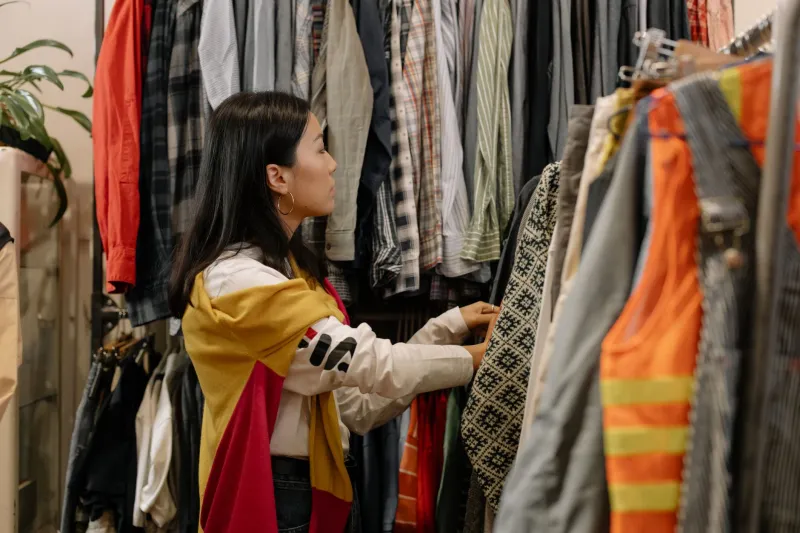
There's a tax nobody tells you about when you're standing in a dressing room, holding a perfectly acceptable gray blazer you don't love but could probably wear to anything. It's not on the receipt. It doesn't show up in your bank statement with a line item labeled Psychic Drain or Trend Compliance Fee. But it's there, compounding quietly, every single time you buy something because it's safe instead of something because it's you.
We need to talk about the Confidence Tax — and why the weirdos, the maximalists, the people who show up to a Tuesday morning meeting in a jacket that looks like a tropical fish had an argument with a quilt, are quietly, counterintuitively winning.
The Trend Hamster Wheel Has a Cover Charge
Here's how the cycle works for the average American shopper trying to stay presentable and inoffensive: you buy something neutral because it goes with everything. It goes with everything but excites you about nothing. Six months later, the specific shade of beige you chose is no longer the right shade of beige — somehow taupe is back and you missed it. So you buy again.
This is not a small problem. The average American spends somewhere north of $1,800 on clothing annually, and a significant chunk of that is replacement purchasing — swapping out items that technically still work but feel suddenly, vaguely wrong. Trend cycles have compressed so aggressively (thank you, fast fashion, very cool, very sustainable) that a "classic" piece can feel dated within a year if it was ever trend-adjacent to begin with.
Now compare that to someone who bought a pair of wide-leg trousers with a print that looks like a 1970s fever dream. Nobody's going to tell them that piece is suddenly out. It was never in in the conventional sense — it existed outside the trend cycle entirely. You can't obsolete something that never asked permission to exist.
Statement pieces and genuinely weird clothing have a surprisingly long shelf life precisely because they're not chasing a moving target.
The Emotional Budget Nobody Accounts For
Money is only part of the equation. The more insidious cost of safe dressing is what it does to your head.
Every morning you stand in front of a closet full of interchangeable neutrals and feel nothing, that's a small withdrawal from your energy account. Decision fatigue is real, but so is inspiration debt — the cumulative drag of getting dressed in a way that requires zero enthusiasm and produces zero joy. You're not saving mental energy by owning only clothes that blend in. You're spending it on low-grade dissatisfaction every single day.
There's also the performance cost. Safe dressing is, paradoxically, exhausting to maintain. You're constantly calibrating: Is this formal enough? Is this too casual? Will this read as trying too hard, or not hard enough? The person who walked in wearing something genuinely unexpected has already opted out of that entire anxiety spiral. They made a choice that was theirs, and now they're done thinking about it.
That's not recklessness. That's efficiency.
People-Pleasing Has a Terrible ROI
Let's be honest about what a lot of "safe" clothing purchases actually are: they're preemptive apologies. They're buying something you're fairly sure nobody will have an opinion about, because having an opinion about your outfit feels risky. The logic is understandable. The math is terrible.
Here's what you're actually buying when you purchase something to avoid judgment: temporary, conditional acceptance from people who probably weren't paying that close attention anyway. It's a subscription service with no real benefits and a monthly fee you pay in both dollars and self-expression.
Meanwhile, the person who commits to dressing in a way that reflects an actual personality — even a chaotic, maximalist, "why is there fringe on that" kind of personality — is building something different. They're accumulating a reputation. A presence. A wardrobe that tells a story instead of refusing to speak.
And here's the kicker: most people respond more positively to genuine confidence in a weird outfit than to a perfectly executed safe one. The blazer that fits impeccably and matches everything is forgettable. The jacket that looks like it was designed by someone who really, really loves both cowboys and outer space is a conversation.
The Cost-Per-Wear Math Hits Different for Statement Pieces
Fashion people love the cost-per-wear calculation, and for once, it actually supports the chaotic dresser's case.
A $40 trend piece you wear twice before it feels wrong costs you $20 per wear. A $120 statement piece you wear fourteen times because it makes you feel like a main character every single time it's on your body costs you $8.57 per wear. The math isn't subtle.
More than that, genuinely distinctive clothing tends to get remembered — which means you can repeat it more without social penalty. Nobody's tracking whether the person in the memorable printed pants wore them three weeks in a row. But everyone notices if you show up in the same forgettable navy chino twice in one week. Irony is a funny thing.
What You're Actually Investing In
Buying clothes that reflect who you actually are — or who you want to be, or who you are on days when you're feeling brave — is not a frivolous act. It's an investment in the version of yourself that takes up space without apologizing for it.
That doesn't mean spending more. In fact, it often means spending less, more deliberately. One extraordinary piece that you reach for constantly because it makes you feel like you showed up to your own life beats a drawer full of acceptable options you cycle through on autopilot.
Thrift stores, vintage shops, independent brands doing genuinely strange things with fabric — these are full of pieces that will never go out of style because they were never trying to be in style. They're just good. Weird and good. Specific and good. Yours, if you want them.
The Bottom Line on Boring
Playing it safe in your wardrobe is not the conservative financial choice it appears to be. It's a recurring subscription to a trend cycle that doesn't care about you, an emotional tax on your daily energy, and a social strategy with genuinely mediocre returns.
Dressing in a way that's actually yours — loud, specific, occasionally baffling, unapologetically committed — costs less money in the long run, costs less mental energy every morning, and pays out in the kind of confidence that doesn't require anyone else's approval to hold its value.
The weird outfit isn't the risk. The boring one is.
Wear the unexpected. Own the room. And maybe stop paying taxes you never agreed to.