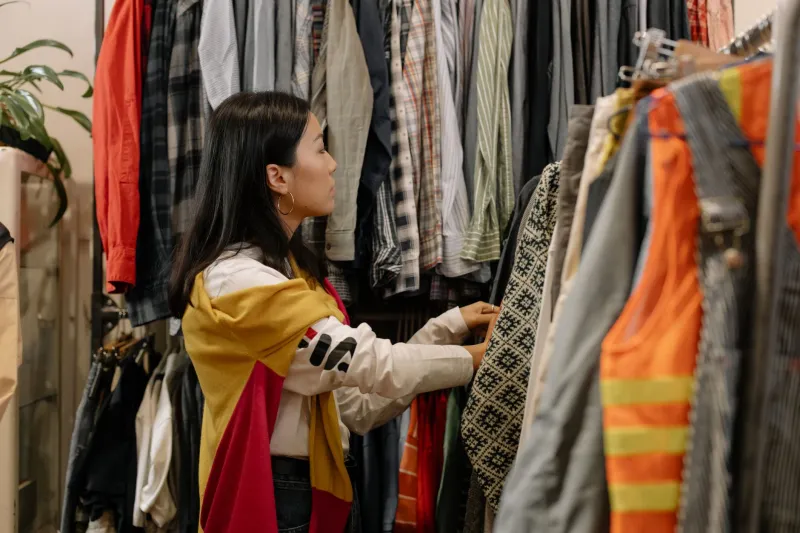
Broke and Unstoppable: Why the $6 Goodwill Shirt Hits Different Than the $200 One
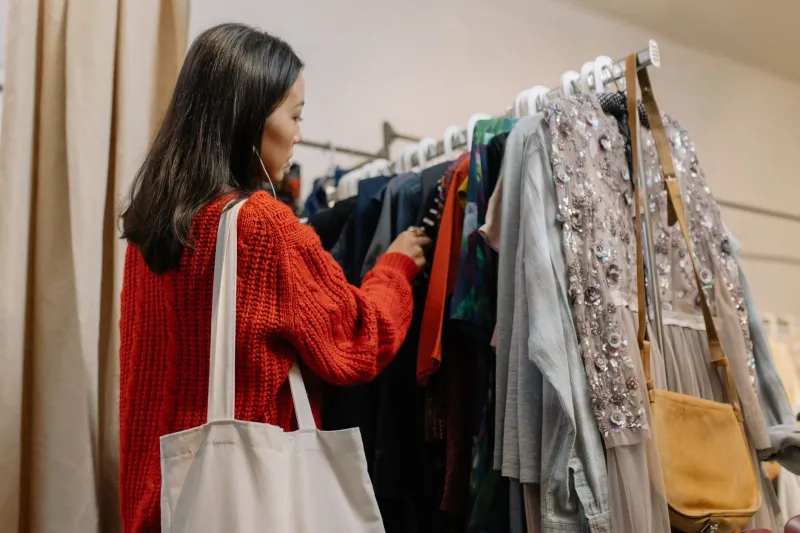
Something deeply unfair is happening in the fashion world, and the people who've accidentally figured it out are walking around Targets and Goodwills across America looking completely unbothered while the rest of us are refreshing our bank apps in the Nordstrom parking lot.
The secret isn't a trend. It isn't a silhouette. It isn't even good taste, technically. It's this: the less you spend on a piece of clothing, the more confidently you can wear it. And that confidence — raw, uncut, slightly chaotic — is the most expensive-looking thing in any room.
Welcome to the confidence arbitrage. Population: everyone who's ever rocked a $6 find like they invented fabric.
The Expensive Outfit Has Something to Prove
Here's a thought experiment. You spend $220 on a sweater. It's nice. It's soft. The tag has a name on it that makes the salesperson act slightly warmer toward you. You get home, hang it up, and then — here's the part nobody talks about — you start protecting it.
You don't wear it on days when it might rain. You don't wear it to that friend's apartment where the dog jumps. You sit differently in it. You eat carefully. You check for pills every third wear and feel personally attacked when one appears. You've essentially purchased a small, wearable anxiety.
Worse: you've created a fragile feedback loop. The sweater needs to justify its cost. Every time you wear it, you need people to notice it, compliment it, confirm that the $220 was a reasonable human decision. You are not wearing the sweater. The sweater is wearing you, and it's charging by the hour.
Now contrast that with the person who found a genuinely unhinged vintage bowling shirt at a Salvation Army in Akron for $4.50.
The $4.50 Bowling Shirt Doesn't Care
When there's nothing to protect, there's nothing to lose. And when there's nothing to lose, something strange and wonderful happens to your posture.
The thrift store find has no expectations attached to it. Nobody's going to tell you it's last season, because it's literally from a season that doesn't have a name anymore. Nobody can undercut it on sale. Nobody else is wearing one, because the entire premise of secondhand shopping is that you are the only person who thought to grab that particular item off that particular rack on that particular Tuesday.
You didn't buy a status symbol. You bought a conversation. And you bought it at a price point where the worst case scenario — someone doesn't like it — costs you exactly the emotional equivalent of losing a game of Uno. Mildly annoying. Completely recoverable.
This is the core of the confidence arbitrage. The psychological risk is almost zero. Which means the psychological reward — wearing something genuinely weird with genuine conviction — is almost unlimited.
Why Full Conviction Is the Actual Flex
Fashion culture has spent decades trying to sell you the idea that quality materials and designer names create confidence. And sure, a well-made piece can make you feel good. Nobody's disputing that a pair of pants that actually fits is a gift to yourself.
But confidence that depends on price point is structurally fragile. It's confidence with terms and conditions. It requires external validation — the compliment, the recognition, the knowing glance from someone who can read the label from across the room — to keep functioning. Remove those conditions and the whole thing collapses into a pile of expensive insecurity.
Wearing a $6 Goodwill find with full, zero-apology conviction is a completely different psychological animal. It says: I decided this was good. My deciding it is sufficient. Your opinion is noted and filed in a drawer I'm not going to open.
That's not arrogance. That's actually just a healthy relationship with your own choices. It's also, not coincidentally, the energy that makes people across a party stop and think, "Wait, what is that person wearing and why does it work so well?"
The Thrift Math Nobody Does Out Loud
Let's run the actual numbers here, because it's kind of wild when you say it plainly.
You spend $180 on a "classic" basic that's supposed to be the foundation of your wardrobe. You wear it carefully. You feel mild dread every time it goes in the wash. After two years, it's developed a small hole near the hem that feels like a personal failure. You've gotten roughly 40 wears out of it. That's $4.50 per wear, and a non-trivial amount of low-grade stress.
You spend $6 on a vintage Western shirt with embroidered cactuses that you found between a Members Only jacket and a truly haunted blazer. You wear it constantly because who cares, it cost $6. You wear it to brunch, to work, to a wedding as a conversation piece. You wear it until it disintegrates from joy. You've paid approximately $0.08 per wear and experienced nothing but the specific pleasure of owning something nobody else has.
One of these transactions made you more confident. The math is not subtle.
How to Actually Do This (Without Losing Your Mind)
The good news is that the confidence arbitrage isn't a technique you learn. It's a permission you give yourself. But here are a few practical notes for getting there:
Stop treating cheap as a synonym for bad. A $6 shirt from Goodwill isn't a lesser shirt. It's a shirt with a history, a personality, and a price tag that frees you from caring whether it earns its keep.
Go in without a plan. The thrift store finds that become wardrobe legends are almost never the ones you went looking for. They're the ones that stopped you mid-aisle and made you go, "Wait, is this insane? ...I'm getting it."
Wear the thing immediately. Don't let it sit in your closet while you build up the nerve. The first wear is always the hardest, and also the one where you discover it's not actually that scary and people are mostly focused on their own problems.
Own the provenance. "I got this at a Goodwill in Cleveland for six dollars" is a better story than "it's from [brand name]." One of these answers makes people curious. The other makes them nod politely.
The Tuba Pants Theory of Cheap Confidence
Here at Tuba Pants, we've built an entire editorial identity around the idea that the most powerful thing you can do with clothes is wear them like you meant it — whatever it is. That applies equally to a structured blazer and an absolutely chaotic thrift store windbreaker from 1994.
But the windbreaker has a slight edge. Because the windbreaker costs less than a fast food combo meal, and yet somehow it commands more attention, generates more conversation, and produces more genuine confidence than things that cost fifty times as much.
The expensive outfit is trying to earn something. The $6 find already has it.
Wear the unexpected. Own the room. Preferably in something that cost you less than a movie ticket. The confidence is already yours — the thrift store just helps you remember that.