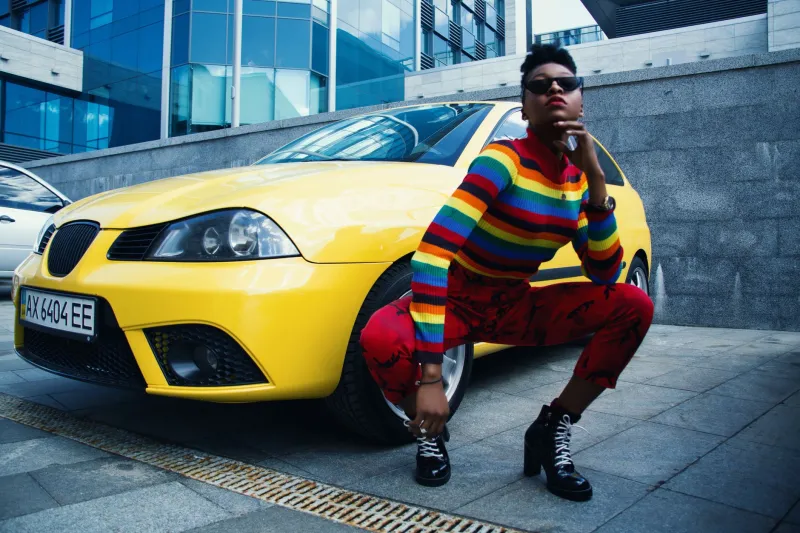
Try-Hard Is Dead: The Counterintuitive Power of Looking Like You Almost Didn't Bother

Somewhere between the person who spent forty-five minutes constructing the perfect business-casual ensemble and the person who rolled out of bed, grabbed whatever was on the floor, and walked into the same meeting looking inexplicably cool — something went sideways in the rules of dressing. And honestly? Good.
We need to talk about the paradox nobody in fashion wants to fully admit: the most powerful outfit you can wear is the one that looks like you didn't think about it at all. Not because effort is bad. But because visible effort has become the new desperation.
The Myth of the Polished Arrival
For decades, the American workplace — and honestly, American culture at large — operated on a simple equation: more effort equals more respect. Iron your shirt. Match your belt to your shoes. Look like you tried. The subtext was always the same: I take this seriously, so you should take me seriously.
And sure, that worked. For a while. But something shifted. Maybe it was Silicon Valley billionaires in hoodies closing billion-dollar deals. Maybe it was Virgil Abloh in a beat-up tee standing next to heads of state. Maybe it was just the collective cultural exhaustion of performing effort for an audience that stopped clapping.
Whatever caused it, the signal flipped. Now, the person who looks slightly unbothered? They're the one everyone in the room is quietly trying to read.
What 'Effortless' Is Actually Communicating
Here's the thing nobody tells you about strategic nonchalance: it's not actually nonchalance. It's a very deliberate, very calculated choice wrapped in a costume that says I woke up like this.
When you walk into a space in a slightly oversized vintage jacket, a T-shirt that has absolutely no business looking that good, and pants that fit in a way that defies conventional tailoring logic — you're not signaling that you don't care. You're signaling that you care so little about what other people expect that you've moved entirely past it. That's a different thing. That's confidence with the serial numbers filed off.
Psychologists who study self-presentation have a term for this: strategic detachment. The idea is that by visually opting out of the conventional hierarchy of status dressing, you sidestep the whole competition. You can't be judged by rules you've publicly declined to play by. And in a room full of people anxiously trying to nail the right look, the person who appears to have transcended the question entirely holds all the power.
The Tuba Pants Theory of Nonchalant Domination
Let's be clear about something. This isn't about dressing badly. It's about dressing interestingly, with a studied looseness that makes people wonder what else you know that they don't.
Think of it like a tuba. Nobody looks at a tuba and thinks that person is trying too hard to be noticed. A tuba is just a tuba — big, unapologetic, doing its thing, completely indifferent to whether it fits neatly into the brass section's aesthetic expectations. And yet the tuba is always the most interesting instrument in the room. You don't forget the tuba.
That's the energy. Not chaos for chaos's sake. Not sloppiness dressed up as philosophy. But a deliberate weirdness that communicates: I made a choice here, and I'm not explaining it.
How to Actually Pull This Off Without Just Looking Like You Forgot to Do Laundry
This is where most people fumble. There's a real difference between intentional effortlessness and I genuinely forgot to do laundry. The line is thin but crucial.
Fit is your secret infrastructure. The whole illusion depends on clothes that, even when they look thrown-together, are actually doing something right. An oversized shirt works when the shoulder drop is deliberate and the length is interesting. It doesn't work when it's just a shirt that's too big. You're building a structure and then artfully messing it up — not starting from no structure at all.
One thing has to be doing real work. In any genuinely effortless-looking outfit, there's always one piece that's quietly exceptional — a coat with a great silhouette, a shoe that's doing something unexpected, a single accessory that's so specific it could only have been chosen on purpose. That's the tell. That's the piece that lets the whole thing read as intentional rather than accidental.
Wear it like you've worn it a hundred times. This is the part that can't be faked with a credit card. Comfort in your clothes reads as confidence. If you're tugging, adjusting, or glancing down to check on things, the illusion evaporates. The 'I didn't try' outfit requires more internal commitment than the suit-and-tie uniform, not less.
Why This Disrupts the Whole Hierarchy
Conventional power dressing operates on legibility. The suit says I am serious. The uniform says I belong here. The expensive watch says I have arrived. All of these are communications designed to be instantly decoded by anyone who knows the code.
The effortless outfit refuses to be decoded. It doesn't participate in the same semaphore. And that refusal is itself a power move — because it forces everyone else to reckon with you on different terms. You're not asking to be evaluated by the existing rubric. You're suggesting, politely but firmly, that the existing rubric is kind of beside the point.
In American culture especially, where we love a legible success signal — the corner office, the luxury car, the power blazer — showing up in something that can't be easily filed and categorized is quietly radical. It says you don't need the shorthand. You'll just be the thing itself.
The Long Game
None of this is new, exactly. Style icons from James Dean to Katharine Hepburn to every cool person you've ever envied at a party have understood this intuitively: the goal was never to look like you were trying to be cool. The goal was to look like cool was simply your default state and you'd never considered an alternative.
The difference now is that we can be intentional about it. We can study the architecture of effortlessness, understand what makes it work, and build it deliberately — which is a little bit funny, and also completely fine. Most great things are a paradox up close.
So the next time you're standing in front of your closet at 7 a.m. trying to decide whether to go full effort or full chaos: consider the third option. The one where you spend twenty minutes constructing something that looks like you spent zero, walk out the door, and let the room spend the rest of the day trying to figure out your whole deal.
That's the move. Wear the unexpected. Own the room. Look like you almost didn't bother.
Almost.